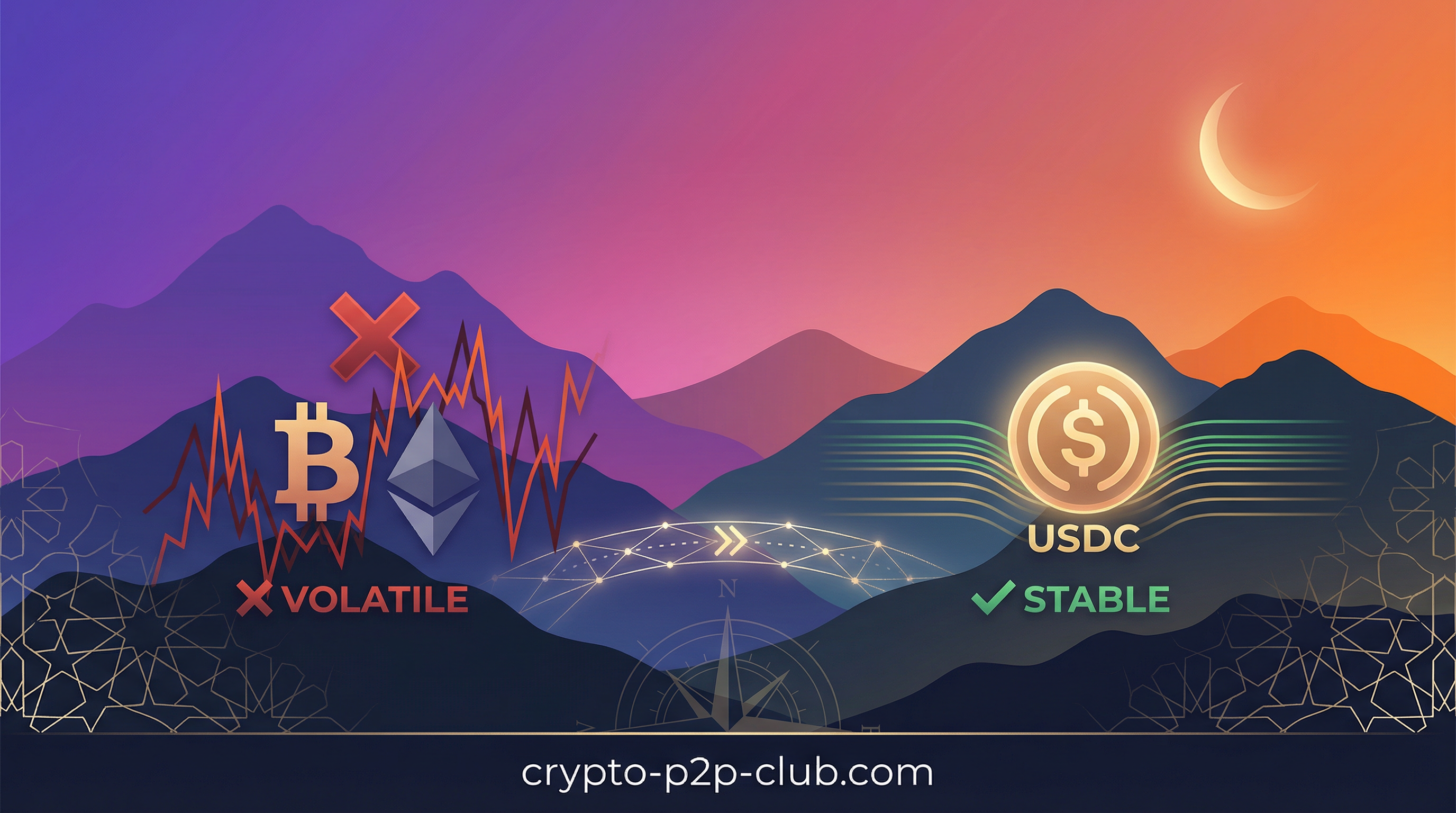
In the Muslim community, the debate over cryptocurrencies is often intense and polarized. Between accusations of speculation (maysir), uncertainty (gharar), and a lack of intrinsic value, many Muslims remain wary, if not hostile, towards this asset class. Yet, one category of digital assets escapes this near-universal criticism: stablecoins.
How can this paradox be explained? Why do even the most ardent crypto detractors have no problem holding digital dollars (like USDC or USDT) and using them for payments or remittances? The answer lies in a fundamental principle, often forgotten in the speculative frenzy: utility before speculation.
The Root of the Problem: Technology vs. the Asset
As experts in the field point out, the rejection is generally not aimed at the blockchain technology itself. After all, a blockchain is, at its core, just a large ledger, a distributed and secure database. The real point of friction for Muslim investors lies in the asset being traded: the crypto token, whose value is often disconnected from any real utility and subject to extreme volatility, akin to a game of chance.
Islamic finance is less concerned with the wrapper than with the reality it contains.
When blockchain technology is used to represent something familiar and useful—like the U.S. dollar—and makes its use more efficient, the objection disappears. The tool is then judged on its merit and its concrete utility.
The Game-Changing Use Case: Remittances
One of the most striking examples of the utility of stablecoins is international money transfers (remittances). For millions of people worldwide, sending money to their families in their home countries is a costly and slow ordeal through traditional systems like Western Union or bank transfers.
Using stablecoins radically changes the game. A USDC transfer from one country to another takes a few seconds and costs only a few cents, compared to several days and exorbitant fees for conventional methods. This is a concrete use case, a solution to a real problem affecting millions of families.
SFor example, sending stablecoins to one's family living aborad is "better and cheaper than traditional solutions. It's no longer about speculating on the future value of a token, but about using a tool to accomplish a task more efficiently. The intention (niyyah) is not speculative gain, but the transfer of value.
Utility Before Speculation: An Islamic Principle
This distinction is at the heart of the Crypto P2P Club's philosophy: Learn, Hold, Share.
- Learn: Understand that blockchain is a tool and that the value of a digital asset must be assessed by its utility.
- Hold: Prioritize holding assets that have a clear purpose and function, rather than chasing quick and uncertain gains.
- Share: Use these tools to create value, help the community, and solve concrete problems.
Stablecoins, in their simplest form, embody this principle. They don't promise 1000% returns, but they offer a service: a stable, fast, inexpensive, and transparent means of payment and value transfer.
| Feature | Speculative Token (e.g., Meme Coin) | Stablecoin (e.g., USDC) |
|---|---|---|
| Main Objective | Capital gain through price appreciation | Value stability, medium of exchange |
| Source of Value | Hype, speculation, market sentiment | Backed by a real asset (dollar, gold) |
Compliance (Maysir) |
High (resembles gambling) | Low (value is stable by design) |
| Concrete Utility | Often low or non-existent | High (payments, transfers, savings) |
Conclusion: A Tool for the Community
The stablecoin paradox is, therefore, not a paradox at all. It reveals a mature and pragmatic understanding of the technology by the Muslim community. The rejection is not of the technology, but of its use for purely speculative purposes disconnected from the real economy.
By offering a tangible solution to real problems, stablecoins demonstrate that blockchain can be a formidable tool in the service of the objectives of Islamic finance (maqasid al-shariah), such as the preservation of wealth and the facilitation of trade. They remind us that the true value of an innovation is not measured by its popularity, but by its positive impact on people's lives.