The Weakest Link in Security Is Often Us
In the world of cryptocurrency, one adage is constantly repeated: "Not your keys, not your crypto." To address this, hardware wallets have become the gold standard for anyone serious about securing their assets. These small, USB-like devices keep your private keys offline, safe from online hackers. They are the ultimate digital safe. But what happens when, for the sake of convenience, you leave the key to the safe on the door?
The tragic story of Brandon LaRoque, an American retiree who watched his life savings of over $3 million evaporate in minutes, is a painful but essential lesson. His one mistake made his hardware wallet as vulnerable as a simple app on his phone. This article breaks down his story, not to scare, but to educate, in line with the Crypto P2P Club's vision of "Learn, Hold, Share."
The Story of Brandon LaRoque: A Fortune Lost with a Click
In October 2025, Brandon LaRoque, a 54-year-old from North Carolina, was preparing to enjoy a well-deserved retirement with his wife, funded by years of investing in XRP. He had accumulated a colossal sum, exceeding $3 million, and to secure it, he used the best available technology: an Ellipal Titan 2.0 hardware wallet, a device known for its "air-gapped" security (completely disconnected from the internet) [1].
On October 15, while checking his balance via the mobile app, he discovered the unthinkable: his wallet was empty. After investigation, he realized the theft had occurred three days earlier. Hackers had managed to siphon off almost all his funds in a few quick transactions.
How is this possible? How could a wallet designed to be inviolable be emptied? The answer is as simple as it is devastating.
The Fatal Mistake: When "Hot" Burns "Cold"
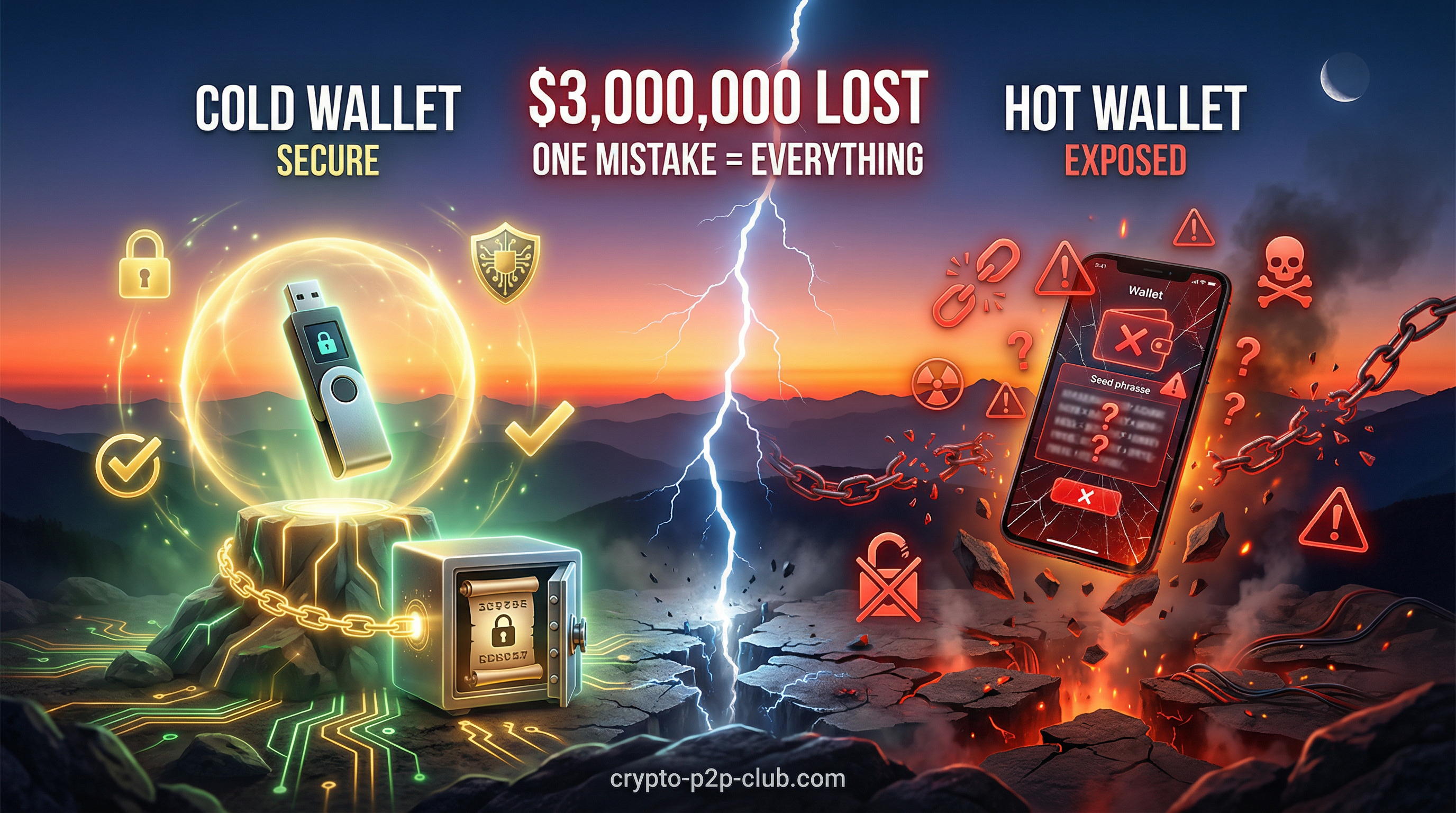
For convenience, Brandon had imported his hardware wallet's recovery phrase (his 12-word seed phrase) into a software wallet application on his tablet, an internet-connected device. In doing so, he unknowingly wiped out all the security of his device.
He turned his secure, offline cold wallet into a vulnerable, online hot wallet. The private keys, which should never have left the physical device, were exposed on a connected device. That was all a hacker needed to retrieve them and take full control of his funds.
The company Ellipal confirmed that the error was on the user's part: "If you type a cold wallet's seed phrase into the app, [...] the private keys are stored on your device, effectively turning it into a hot wallet and significantly reducing security" [1].
The Golden Rule of Financial Sovereignty
Brandon's story is a perfect illustration of the responsibility that comes with financial sovereignty. Owning your keys means being your own bank, but it also means being your own head of security. There is an absolute, non-negotiable rule that every cryptocurrency holder must carve in stone.
NEVER, under any circumstances, enter your hardware wallet's recovery phrase on an internet-connected device (computer, smartphone, tablet).
Your recovery phrase is the master key to your fortune. It should only exist on a physical medium (paper, metal), stored in a safe place, offline. Entering it into software, a browser extension, or a mobile app is like giving a copy of your safe's key to the first person you meet on the internet.
| Wallet Type | Security | Use Case | Analogy |
|---|---|---|---|
| Cold Wallet (Hardware) | Maximum | Long-term storage, large amounts | Safe in a Swiss bank |
| Hot Wallet (Software) | Strong but vulnerable | Daily transactions, small amounts | Wallet in your pocket |
Brandon's mistake was putting the contents of his Swiss bank safe into his pocket wallet to access it more "easily."
The Crypto P2P Club Vision: Learn, Hold, Share
This tragedy reinforces our conviction and our motto:
-
Learn: Continuous education is imperative. Understanding the fundamental difference between a hot wallet and a cold wallet is not an option; it's a necessity. Technology cannot protect us from our own mistakes if we don't understand the rules.
-
Hold: True ownership of one's assets (self-custody), which we advocate for with tools like Sahal Wallet, implies absolute responsibility. "Your keys, your responsibility" is the essential corollary to "Not your keys, not your crypto."
-
Share: It is our duty to share these stories and lessons. By informing the community, we make it stronger and more resilient. Brandon's misfortune must serve to protect thousands of other investors.
Sahal Wallet, as a non-custodial wallet, gives you this power and this responsibility. The recovery phrase it generates for you is your most precious asset. Protect it.
Conclusion: Security Is a Process, Not a Product
Buying a hardware wallet is not the finish line of your security journey; it's the starting line. Security is not a product you buy; it's a process, a discipline at all times.
Brandon LaRoque's story is a brutal reminder that in the crypto world, convenience is the sworn enemy of security. A single concession, a single breach of the basic rules, can have irreversible consequences. The $3 million was never recovered.
Learn from this mistake. Be paranoid with your recovery phrase. Never trust a connected device to hold it. This is the price at which the financial sovereignty promised by cryptocurrencies becomes a reality, not a nightmare.
References
[1] CoinDesk. (2025, October 19). XRP Investor Says $3M in XRP Was Stolen; Cold Wallet Maker Says Seed Import Made Wallet Hot. https://www.coindesk.com/tech/2025/10/19/xrp-investor-says-usd3m-in-xrp-was-stolen-cold-wallet-maker-says-seed-import-made-wallet-hot
[2] Gluke. (2025). Cette histoire fait froid dans le dos 😬 #crypto #hardwarewallet [Video]. YouTube. https://youtu.be/DuP1STahwnY
[3] ZackXBT. (2025, October 19). Investigation Thread on X. https://x.com/zachxbt/status/1979899767212699910