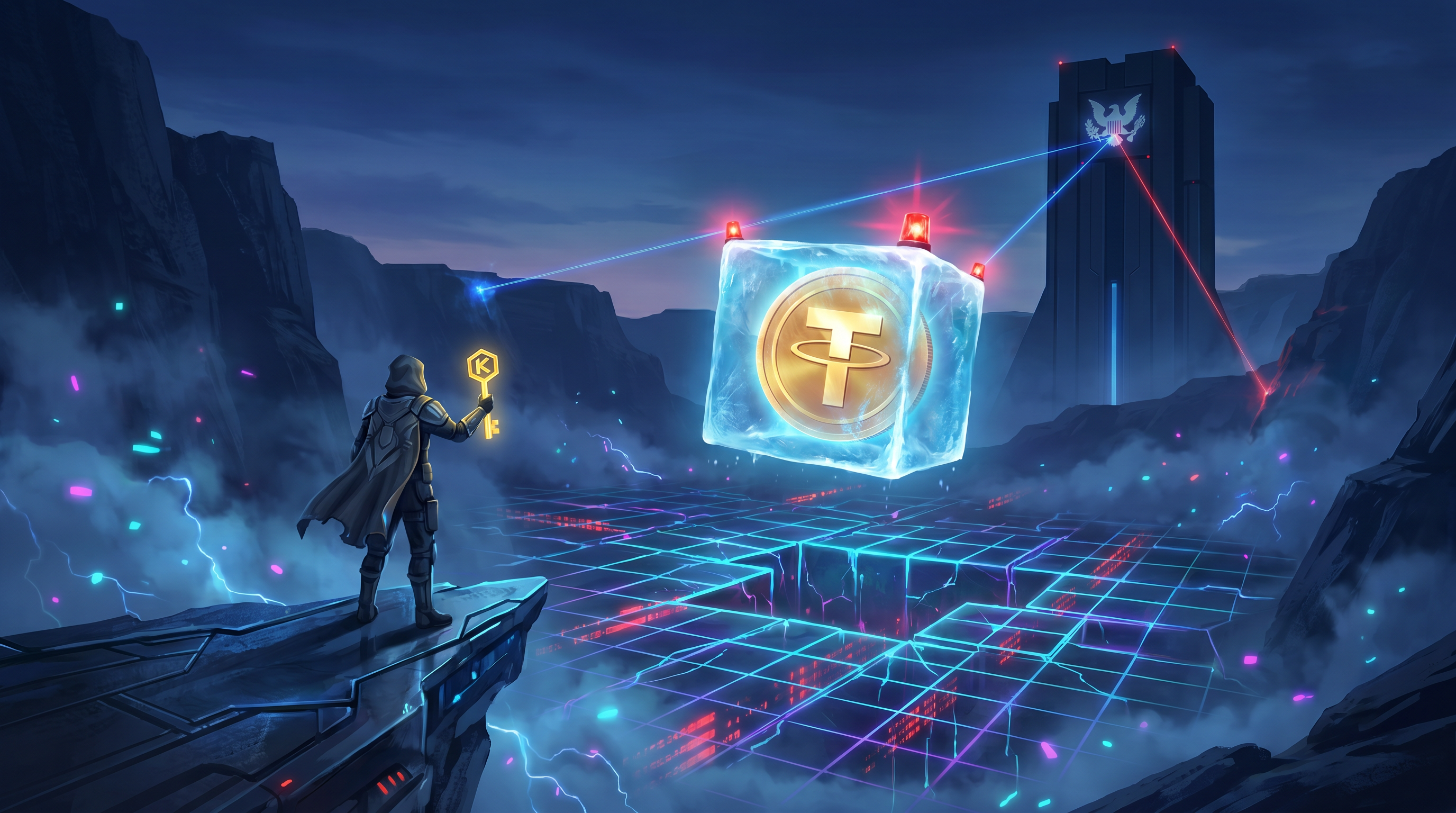
The myth of completely unseizable cryptocurrency has just collided violently with the reality of centralized stablecoins. On April 23, 2026, as part of "Operation Economic Fury," the U.S. government forced Tether to instantly freeze $344 million in USDT on the Tron blockchain [1]. This surgical execution raises fundamental questions about the true nature of decentralization and the security of our digital assets.
The mechanics of an unprecedented freeze
The operation led by the U.S. Treasury's Office of Foreign Assets Control (OFAC) aimed to cut off financial flows linked to the Iranian regime, particularly those of the Islamic Revolutionary Guard Corps (IRGC) [2]. Government analysts, supported by firms like Chainalysis, identified two reserve wallets on the Tron network that had accumulated nearly $370 million since 2021 [3].
The method used to neutralize these funds is revealing. Tether did not need to block the Tron blockchain, which continued to operate normally. The company simply activated a "blacklist" function built into the USDT smart contract [4]. In a matter of seconds, the $344 million became impossible to transfer.
As U.S. Treasury Secretary Scott Bessent stated: "We will follow the money that Tehran is desperately attempting to move outside of the country and target all financial lifelines tied to the regime" [5].
Centralization: A double-edged sword
While blocking funds linked to terrorism or the evasion of international sanctions is understandable from a geopolitical perspective, it highlights a major systemic flaw for the ethical investor. Stablecoins like USDT or USDC are not censorship-resistant.
Their architecture relies on centralized control layered over a public blockchain. Tether has the unilateral power to freeze any wallet, at any time. To date, the company has already blocked a cumulative total of $4.4 billion in assets by collaborating with over 340 agencies in 65 countries [6].
This reality reminds us of an essential lesson: holding centralized stablecoins means accepting counterparty risk. Your funds only belong to you as long as the centralized issuer allows you to use them.
Back to basics: Bitcoin and self-custody
Faced with this vulnerability, the vision of the Crypto P2P Club makes perfect sense. True financial sovereignty can only be achieved through genuinely decentralized assets and self-custody.
Bitcoin (BTC) remains the perfect example of an ethical and censorship-resistant asset. Unlike USDT, no CEO or government has a "Freeze" button to block a Bitcoin transaction. The network is maintained by thousands of independent nodes worldwide, ensuring that the protocol's rules apply equally to everyone.
However, holding decentralized assets is not enough if you leave them on a centralized exchange (CEX). To regain full control, the use of non-custodial wallets is essential.
Solutions like the Sahal Wallet (an ethical hot wallet) combined with a cold wallet (like Ledger or Trezor) offer the best balance between security and accessibility. The Sahal Wallet allows you to manage your assets daily while keeping your private keys, while the cold wallet secures your long-term reserves offline. (If you wish to discover the Sahal Wallet, you can use the referral code 5xbwwut0wrgc during registration to support our community).
Conclusion: Freedom begins with knowledge
Operation Economic Fury is not an anomaly; it is a glimpse into the future. With the arrival of strict regulations like the GENIUS Act in the U.S. or MiCA in Europe, control over stablecoin issuers will intensify [7].
At the Crypto P2P Club, we believe that education is the best shield against these risks. Learning to differentiate a centralized asset from a decentralized protocol, understanding the mechanisms of self-custody, and investing in ethical projects are the essential steps toward financial freedom.
Do not let the security of your assets depend on the goodwill of a centralized entity. Learn, own, share.
Disclaimer: This article is provided for educational and informational purposes only. It does not constitute financial, investment, or legal advice. Always do your own research before making financial decisions.
References
[1] Tether's $344 million USDT freeze linked to U.S. 'Economic Fury' against Iran regime - CoinDesk [2] US sanctions Iran wallets, freezes $344M USDT - CoinGeek [3] US Crypto Crackdown Hits Iran: $500M Seized as Tehran Faces ‘Economic Crisis’ - CryptoTimes [4] Tether Freezes $344M USDT Linked to Iran - Spaziocrypto [5] Treasury Secretary Bessent boasts of seizing $500 million in Iranian assets - TheStreet [6] Tether Supports Freeze of More Than $344 Million in USD₮ - Tether.io [7] Tether Freezes $344M USDT Linked to Iran - Spaziocrypto